Broughton Community Energy
It's about doing what you a can
Like you, perhaps, we are concerned about the effects of climate change. We believe in the science that says it is happening and that our carbon emissions are a signifcant contributor to the problem. We would like for our children to have a bright future to look forward to. And we believe that if everybody does a little bit, it can make a difference. So we want to see if we can reduce carbon emissions in our community.
We are a rural community, off grid, so most people have oil central heating and travel daily by car to the nearest towns and cities for work or leisure. (if you call shopping leisure!). We know that we could reduce the carbon footprint of the village if we could encourage everyone to transition to electric heating and electric cars. But of course it's not that easy for many. It's expensive. Not least because of the high price of electricity. (let's not go into the politics of that here). But if we could generate our own low tariff electricity, that would surely ease the transition.
So our focus is twofold. To generate our own low cost electricity and encourage the transition to electric heating and transport.
You can learn more about the electricity generation here. The adoption of EVs is slowly increasing pace. There are concerns over affordability and range, but both are improving. If you've just driven 200 miles and it is time to fill up, maybe it's good to have a break.
Lets talk about 'retrofit' heat pumps and insulation. The two go hand in hand. Whatever form of heating you use, surely it makes sense to have the house as well insulated as possible? Better insulation = less energy to heat = smaller bills + warmer home! No brainer!
If you are going to go Heat Pump you really do want to make sure that your home is as Energy Efficient as possible.
Home Energy Efficiency
Home energy efficiency is about generating heat more efficiently and retaining it inside our homes, thereby reducing our heating bills and carbon emissions
In future, when Broughton Community Energy is generating our own sustainable low-cost electricity, an electric heat pump will likely be the most efficient way to heat your home, but you’ll only get the full benefits if your home is well insulated.
However, improving your home’s insulation makes good economic and environmental sense today, regardless of whether you decide to switch to a heat pump in the future.
To help you on this journey, we’re delighted to have partnered with My Home Made Better, who can provide valuable advice free of charge.
-
Free house surveys so you know what needs to be done
-
Up-to-date information about grants (you’ll be surprised what grants are available!)
-
Advice on insulation, heat pumps, trusted suppliers and much more
Contact them now (click above) or contact us.
A word of warning. Your boiler will at some point need replacing (fact). Don’t wait until it happens in the middle of a cold winter, panic, and buy the first thing you can. Plan ahead now. Work out what your options will be, what you need to do, what the costs will be.
Want to learn more? ↓
There are two sides to home energy efficiency: getting heat in and keeping heat in. The two need to work hand in hand. If you switch to a heat pump, the size of heat pump you need depends on the energy efficiency of your house. Better insulation can mean a smaller heat pump, which costs less to buy and less to run.

Keeping Heat In

Getting Heat In
Retrofit (Insulation)
Retrofit is the new buzz word - to you and me it means insulation.
Yup, we've all been told about insulation a hundred times before. But have we done anything about it? - nope!
And here are some of our excuses for not doing so.
Why we don't
-
Too Expensive - No pay back
-
Need my loft for storage
-
I already have loft insulation
-
I don't like plastic windows
-
It's too disruptive
Why we should
-
Warmer home
-
Lower heating bills
-
Increase the value of your property
-
Lower carbon emissions
Where to start?
Roof

Roof - is the quick win. 25% of your heat can escape through the loft if you don't have sufficientinsulation. Since 2003 the minimum depth recommendation has been 270mm. So, if your house was built before then, maybe you need a little more? And even if it was built after, it's worth checking.
Loft insulation is not expensive and it's something you might well be able to do yourself. Beware if you see someone offering to spray the inside of the roof. It could cause problems.
Walls
Walls - a little more complicated but can reduce heat loss by up to 35%. If you have cavity walls getting insulation injected is fairly straight forward. Most importantly it is important to speak to a qualified professional about this.

Windows

Windows - can account for another 20% of heat loss. First and foremost are you double-glazed or better triple-glazed. If you are, have they been well maintained, if say the hinges are not working properly then they won't close properly and you'll get more draughts. Maybe you don't like the idea of having all the windows changed. But there are now lots of new and better ways of doing it. For example, take out the existing glass and have vacuum glazed units installed. Much thinner and more effective. Alternatively, there are secondary solutions held onto the frame by magnets, which are easy to remove and clean.
Floors
Floors - another 10-15% could be leaking out that way. Depends if you have timber joist floors or solid. But both can be insulated

Doors

Doors - yup another potential 10%, just through the outside doors not being insulated. Installing draught excluders is cheap and easy, and don't forget the letter box! (did you know the first letter boxes in doors were introduced in 1849)
And there are other tips such as reflector sheets behind radiators. Don't let the heat go through the wall, reflect it back in. Cheap and easy to buy and install.
One very important point is ventilation. You must have adequate ventilation on your house. You want to let the moisture out. But doesn't that then let the hot air out? Again, there is another solution with mechanical ventilation and heat recovery (MVHR), they think of everything now.
Yes, if you were to do all of the above the price might start to add up. But you will get that money back eventually as the price of your property will increase, plus your bills each month would be smaller, and most importantly it will be warmer (and cooler in summer)
Grants - and you might well be able to get grants to help you with this. There are a surprising number of grants available, such as ECO4, ECO4 Flex, Great British Insulation Scheme, Warm Homes Local Grant, Boiler Upgrade Scheme, and Hitting the Cold Spots. The eligibility criteria may be wider than you think, particularly if you have a low EPC rating (below D), and a household income below £36k, or may be Council Tax band A - D. It's worth exploring these through TEC Nor do you have to try to do everything, some bits are better than none. But best results would be all.
So what to do next?
-
Hopefully, what you’ve read will encourage you to think more about the energy efficiency of your home, and maybe, just maybe, take action.
-
There's a huge amount of information out there on the Internet, but beware as always there's also gobbledegook and sharks about.
-
We've partnered with other groups working in the community energy arena, in particular WinACC (Winchester Action on Climate Change) and tEC (The Environment Centre). They are both focussed on our Hampshire area and so are well placed to help us. They've started new initiative called My Home Made Better (MHMB). Here you can find out more detailed information about the above, plus you can contact them for help either on specific topics or in particular about grants.
-
One of the options they offer is an online assessment of your home. Sounds odd, but it's really helpful. They will talk you through the details of your house and make suggestions and provide a written report at the end of it. It helps to focus your mind on what needs to be done.
-
If, after the initial assessment, you would like more in-depth advice, they can arrange a survey and inspection of your home, including thermal imaging of your property (although there is a cost for this more detailed work)
-
We want you to start thinking about this, we'll keep reminding you. You know it's something that makes sense to do.... you just need to do it!
-
Please do contact us if you want and we will do our best to help if we can
Heat Pumps
Let’s talk about heat pumps. There has been a lot of mixed information about them — some fair, some exaggerated, some not totally correct. Yes, they do work. Yes, they work in most properties when properly designed. Modern systems are generally quiet. And yes — they work in winter.
They work slightly differently to normal central heating. Instead of the heating coming on in the morning, warming the place up, then going off again, back on again in the evening. Heat Pumps are on the whole time giving you a consistent level of heat throughout the day.


How do they work?
A heat pump does not create heat like a boiler (which burns oil to produce very hot water). Instead, it moves heat around. They grab heat from an outside source, normally air, then increases the heat value by compressing it (think of a bicycle pump how it heats up at the bottom when you are compressing air to get it in to the tyres) then passes the heat on in to your house. That's why it is called a 'heat' 'pump'!
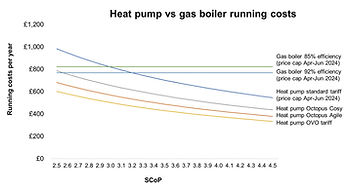
They deliver heat more efficiently than a boiler. Both oil and electricity contain energy. That’s what we pay for. For every 1 kWh of energy used by a heat pump, it can deliver roughly 2.5–4 kWh of heat into your home.
An oil boiler, by comparison, is typically around 85–90% efficient — so for every 1 kWh of energy in the oil, you get around 0.85–0.9 kWh of useful heat.
Heat pumps are more efficient because they move heat rather than create it. That doesn’t automatically mean they are always cheaper to run — electricity costs more per unit than oil — but running costs can be similar or lower depending on tariffs and insulation levels.
More technical stuff
A Oil Boiler typically runs at temperatures of 70-80 C a Heat Pump more around 40 - 45 C. So the radiators won't feel scorchio to touch, but pleasantly warm instead. So the idea is that you keep it running all day at a pleasantly warm temperature. Not really warm at one point then cooling down the next.
Are there different types of Heat Pump?
Yes there are two main kinds. Air Source (ASHP) and Ground Source (GSHP). There is also Water Source but lets stick with the main two. ASHP grabs heat from the air outside.
GSHP grabs heat from the ground normally through a pipe which has been bored into the ground up to 100m deep.
Depending on the size of the house, this might involve one or more boreholes. Alternatively they can be laid horizontally but you would need an area in the garden about the size of a tennis court. GSHP is more efficient, as the ground temperature is pretty stable all year round around 10 - 12 C. But GSHP is more expensive to install.
Does it just replace my boiler?
Effectively yes. They will plumb in to your existing radiator or underfloor heating system. What they call wet systems. (pipes that run water round the house) They work particularly well with under floor heating.
There is another alternative, called air-to-air. The heat pumps will create hot air rather than hot water and then push that air round the house using units like air-conditioning units. And yes they can also be used for cooling in the summer.
Do I have to change the radiators?
Not necessarily but may be one or two. As mentioned above heat pumps work at a lower temperature than boilers, so you might need more surface area of radiator to work more effectively. Your heat pump installer should (must) do a full room-by-room heat-loss survey of your property to fully understand what is required in your house. Sometime they might need to change a radiator or install new ones. They might for example replace the radiator in the living room, but then re-use that one elsewhere.
They don't work in winter
This is another of those misinformation rumours. Of course they work in winter, why else would people be buying and installing them! :-) Although they are not quite as efficient when it's very cold with CoP down to about 2.0 but still more efficient than an oil boiler CoP 0.85
But how do they work in winter?
Good question, took a while to get my head round this one! 0 C is just a measurement we use. It's zero on the Celsius scale, but there are still molecules moving in the air and those molecules contain energy which can be turned into heat. It's when you get to absolute zero, -273C when everything stops. It doesn't normally get that low here in the UK! :-). And remember inside the heat pump is refrigerant fluid, which is very cold, typically -20C so it thinks that the air from outside at -5C is lovely and warm so it grabs it!
Does this explanation help a bit?
Evaporator (Outside Unit) has cold refrigerant absorbs heat from cold air outside -->
Compressor squeezes gas so it becomes hot -->
Condenser (inside) : releases gas into your heating water which goes on to heat your house -->
Expansion Valve : opens allowing Refrigerant to get cold again which then absorbs more heat from outside.-->
And off we go again.
The fans are noisy.
Noise is often mentioned as a concern. The fans on the modern heat pumps are not noisy. Typically 40-55 dB (decibels) when one metre away. A normal fridge is about 35-40 dB. And of course the fridge is inside the house. Nonetheless, worth thinking about when you have an installation done. Think of your neighbours too!

Is it going to cost me a lot of money?
We'd be lying if we said no. But there are, at the moment, still grants of £7,500 to replace an oil boiler, and recent Government communications have suggested these grants will be in place for a while. An average village house will cost around £5k - £9k to swap over that's everything radiators etc. (after grant deducted) In comparison to swap your boiler like for like around £3k - £6k. In the long term it should cost you less to run. Some people argue that it's not worth it because it will take too long to recover the costs. But they don't seem to use the same argument when replacing their boiler.
Remember this is or should be part of a complete upgrade to your house. First you improve the insulation in your house, then you install a heat pump when you are ready. Your bills are going to be smaller, your house warmer, and you will be doing your bit to reduce carbon emissions and slow the effects of climate change. It's a win / win